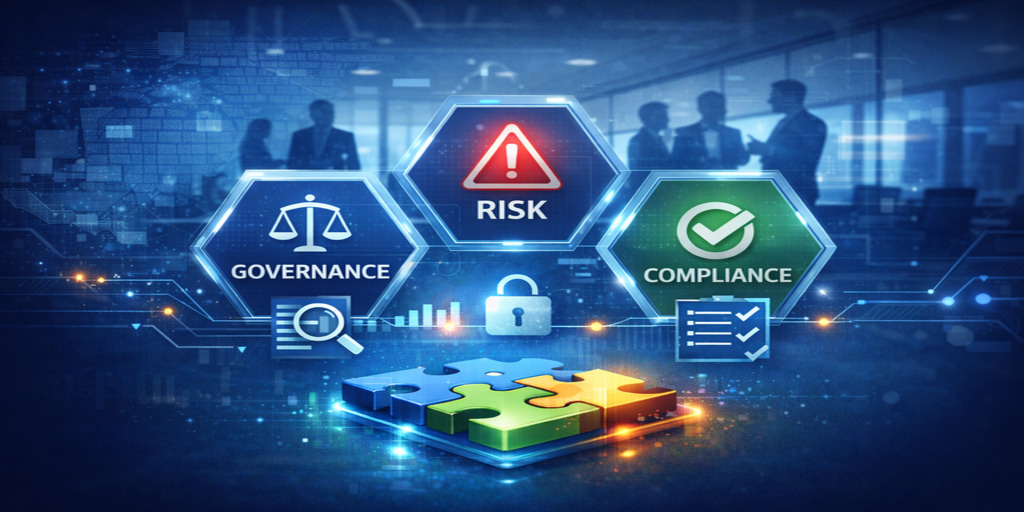
Governance, Risk and Compliance (GRC) has become one of the most recurrent topics on the agendas of Boards of Directors. Regulators are stricter, investors more attentive, the competitive environment more volatile and the risks more complex - be they regulatory, technological, reputational or strategic.
Yet, despite the growing attention to the subject, most organizations fail to structure a CRM model that really works.
It's not for lack of frameworks.
It's not because of a lack of standards.
And even less because of a shortage of tools.
The failure occurs because GRC is treated as three parallel initiatives - and not as an integrated management architecture.
Governance is led by the Board.
Risk Management is the responsibility of a technical area.
Compliance acts as a control and inspection function.
These structures exist. But they operate in a disconnected way.
The result is a fragmented model, where:
- The strategy is not linked to critical risks.
- Risks are not integrated into the executive indicators.
- Compliance acts reactively.
- The controls are not evaluated in terms of their actual effectiveness.
In this scenario, the organization may seem structured on paper - but it remains vulnerable in practice.
GRC should not be seen as a regulatory obligation. It is organizational nervous system.
When structured correctly, GRC:
- Increases strategic predictability
- Reduces exposure to critical risks
- Increases the quality of decisions
- Protects institutional reputation
- Sustain growth with control
But this only happens when Governance, Risks and Compliance stop operating in silos and form an integrated management model.
The Problem: Fragmented GRC
In many organizations, Governance, Risk and Compliance function as independent areas.
The fragmented model generates:
- Strategy disconnected from risk
- Document risk management
- Isolated compliance
- Unmonitored controls
Result: apparent control, real vulnerability.
Where companies go wrong - with practical examples
- Governance disconnected from risk management
A common real-life scenario:
A company decides to expand into new regulated markets. The Board approves the plan on the basis of financial projections, but without a structured analysis of regulatory risks.
Months later, fines and unforeseen operational restrictions appear.
The problem wasn't the strategy - it was the lack of integration between Governance and Risks.
- Risk management as a documentary activity
The risk matrix is updated annually, presented and filed.
No continuous monitoring.
No executive indicators.
No responsible people with binding targets.
When an incident occurs, it turns out that the risk was already mapped.
Risk identified without action is just a historical record.
- Isolated and reactive compliance
Compliance reviews contracts and creates policies, but does not participate in strategic definition.
The operational areas see the function as an obstacle, not a support.
Without integration, compliance loses internal legitimacy.
- Controls without evaluation of effectiveness
An organization has hundreds of formal controls.
In an external audit, it is discovered that many are not carried out as planned.
Control without monitoring is presumed control - not real control.
The Integrated Model: GRC 360°
An integrated model connects:
- Governance → Defines direction and risk appetite
- Risk Management → Identifies uncertainties that impact objectives
- Compliance → Ensures regulatory adherence
In the center is the Strategy & Performance.
When integrated:
- Risk influences strategic decisions
- Compliance participates in the definition of policies
- Executive indicators reflect real exposure
GRC is no longer a department but an organizational architecture.
Integrated GRC Operational Architecture
A mature CRM model operates in layers:
- Strategic direction
Objectives, targets and definition of risk appetite.
- Structural Governance
Roles, responsibilities, policies and committees.
- Integrated Risk Management
Consolidated matrix, impact assessment and mitigation plans.
- Controls & Compliance
Policies, internal controls, risk-based auditing.
- Monitoring & Executive Intelligence
KPIs, KRIs, dashboards and reporting to the Board.
The cycle is continuous:
Strategy → Risks → Controls → Monitoring → Decision → Strategic Adjustment.
What changes when GRC is integrated
Organizations with fragmented CRM
- Strategy without integrated risk matrix
- Risks assessed annually
- Reactive compliance
- Audit identifies failures after incidents
Result: high exposure and low predictability.
Organizations with integrated CRM
- Strategy evaluated with associated risk analysis
- KRIs integrated into the executive dashboard
- Compliance participating in strategic definition
- Continuously monitored controls
The result: evidence-based decisions, fewer surprises and greater institutional trust.
Sector example
Financial sector
Institution connects:
- Operational risk matrix
- Default indicators
- Fraud monitoring
- Regulatory compliance
The Board of Directors starts to anticipate losses before they materialize.
CRM becomes a decision-making tool.
Industrial Sector
Industry integrates logistics risk into production indicators.
Identifies vulnerabilities in a strategic supplier and activates a contingency plan.
Impact mitigated before operational disruption.
That's the power of integration.
Strategic Conclusion
Companies don't fail in CRM because of technical ignorance.
They fail due to structural fragmentation.
When Governance, Risk and Compliance operate in silos, the model generates cost and bureaucracy.
When they operate in an integrated manner, the model generates:
- Predictability
- Resilience
- Institutional security
- Competitive advantage